
Official Statistics on Violent Crime and Sexual Offenses in Portugal (2017–2023)
Portugal’s official data demonstrate that violent crime decreased in the late 2010s (2017–2019) but has risen in the last couple of years, while sexual offenses have shown a steady rise from 2017.


To find reliable data on crime in Portugal, the official government sources are the best starting point. The primary source is the Relatório Anual de Segurança Interna (RASI) – an annual internal security report published by the Ministry of Internal Administration. Each year’s RASI provides nationwide crime statistics (including breakdowns by crime type such as violent crime and sexual offenses) for the preceding year parlamento.ptapcd.pt.
These reports are publicly available (often on government websites or the Assembly’s document portal) and offer year-by-year figures. In addition, the Ministry of Justice’s statistics portal (Sistema de Informação das Estatísticas da Justiça) provides an online database of crimes recorded by police, which allows users to query official crime data by year and by category apcd.ptexecutivedigest.sapo.pt.
This portal contains detailed tables for different crime types (e.g. “crimes against persons,” which include violent and sexual crimes) and is the source of data used in many official analyse sexecutivedigest.sapo.pt. Both the RASI reports and the Justice Ministry’s portal are authoritative and up-to-date sources for tracking trends in violent crime and sexual offenses since 2017.
Trends in Violent Crime (2017–2023)
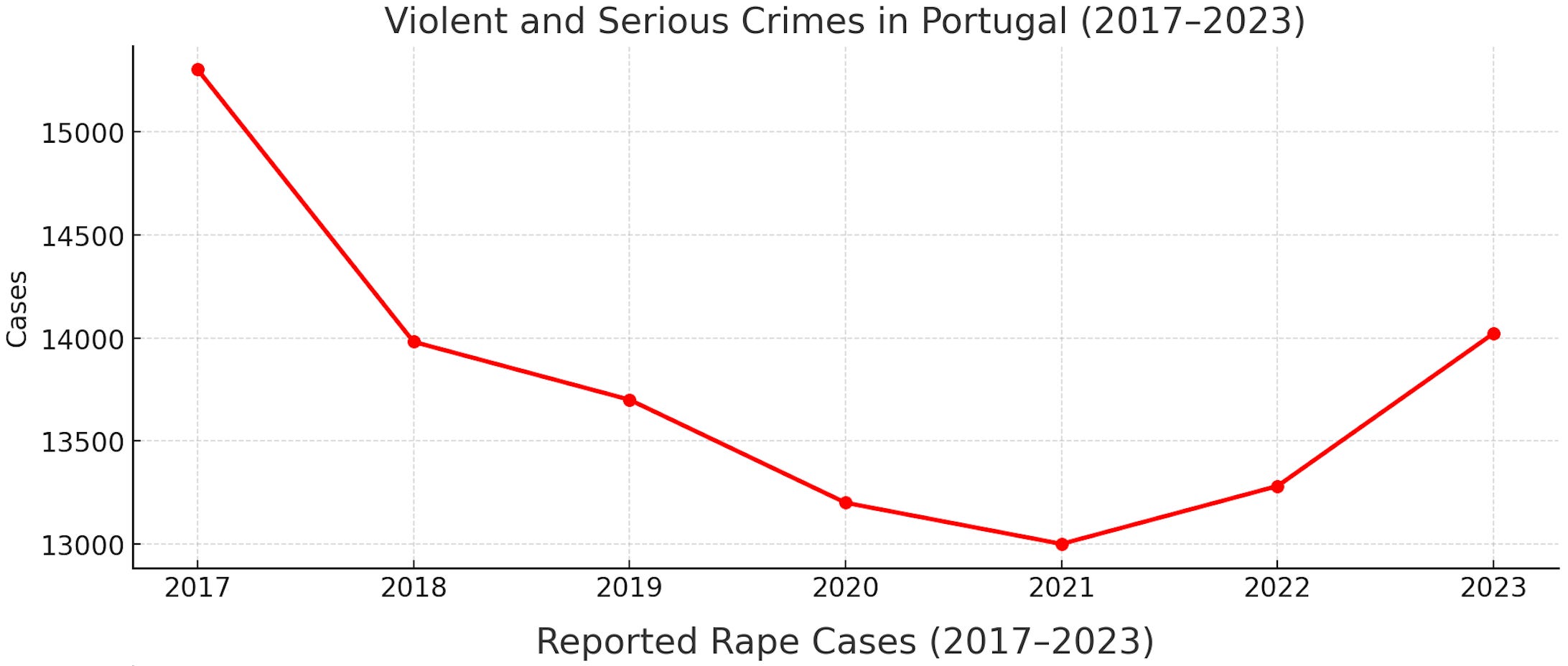
📊 Chart 1: Violent and Serious Crimes
Fell steadily from 2017 to 2021
Rebounded in 2022 and 2023, nearing 2017 levels again
Violent crime in Portugal (often referred to in official reports as “criminalidade violenta e grave”, i.e. violent and serious crime) showed a declining trend in the late 2010s, followed by a recent uptick. According to the RASI data, Portugal saw 15,303 violent crimes in 2017, which was actually a decrease of about 8.7% compared to 2016 parlamento.pt. This downward trend continued into 2018, when violent crime dropped further to 13,981 reported incidents (an 8.6% decline from 2017) apcd.pt. The RASI figures for 2019 indicate that violent crime remained relatively low around this time (2018–2019 being a period of historically low violent crime). During the COVID-19 pandemic years (2020–2021), violent crime fell even further due to lockdowns and restrictions – the RASI notes a “tendência de descida até 2021” (continuing decline through 2021) apcd.pt.
However, post-2020 there has been a rebound in violent crime. In 2022, there were 13,281 violent/serious crimes recorded nationally, a jump of +14.4% compared to 2021 apcd.pt. The most recent data show that 2023 had about 14,022 violent crimes, which is a 5.6% increase over 2022 (though still slightly below the 2017 level )rtp.pt. In sum, while violent crime in Portugal declined from 2017 through 2020, it has risen again in 2022–2023, approaching the levels seen in the mid-2010s.
The RASI reports also detail which specific violent crimes are driving these changes – for 2022–2023, increases were noted in offenses like robberies (e.g. muggings, carjackings) and assaults, after the unusual low crime period during the pandemic rtp.ptportugal.gov.pt. All these figures and trends can be verified in the official RASI publications for each year and the Justice Ministry’s statistical database.
Trends in Sexual Offenses (2017–2023)
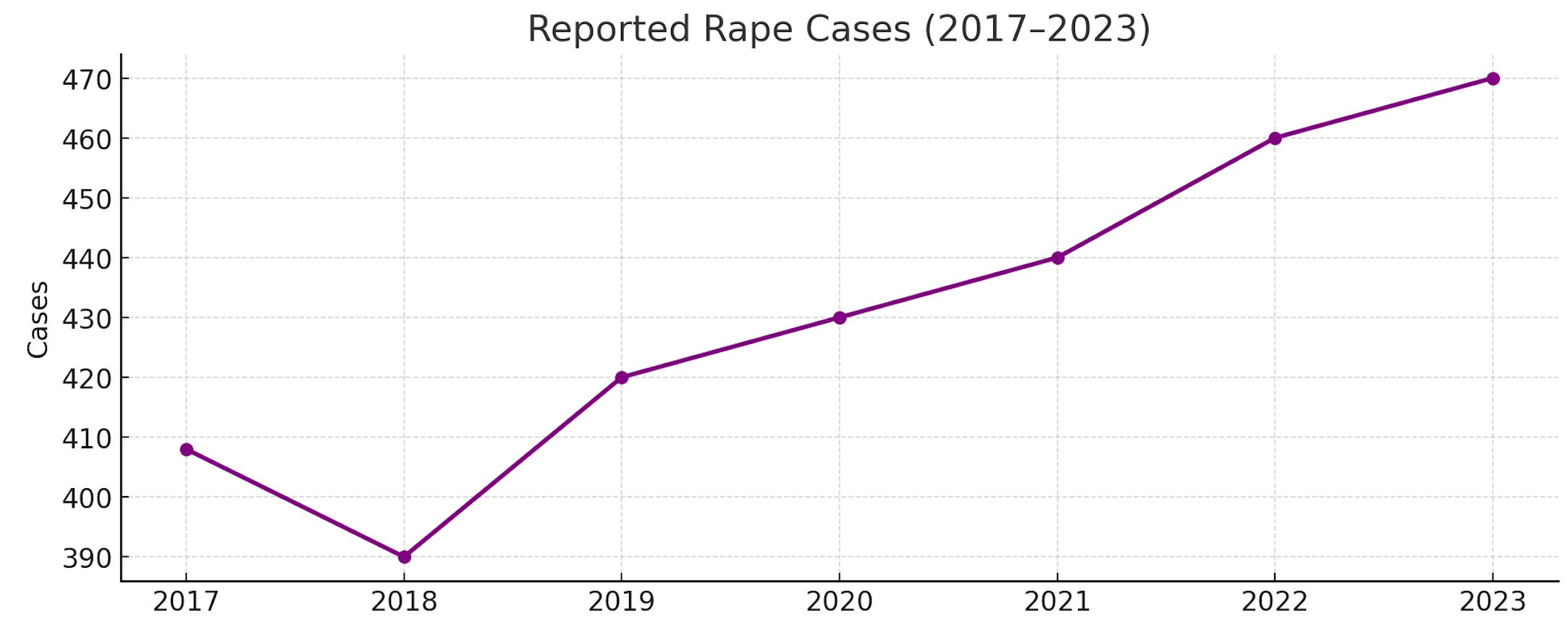
📊 Chart 2: Reported Rape Cases
Increased overall since 2018
From 408 cases in 2017 to 470 in 2023
Sexual offenses (crimes of a sexual nature, such as rape and sexual abuse) have shown an overall rise since 2017 according to official data. The RASI and related statistics indicate that sexual crimes, while part of the broader “crimes against persons” category, have increased both in reported incidence and in share of total crime.
For example, reported rape cases spiked in 2017 – 408 rapes were recorded that year, which was 21.3% higher than in 2016 (when 335 cases occurred) dn.pt. RASI 2017 noted that this was the highest number of rapes reported in Portugal since 2010 dn.pt. In subsequent years, sexual violence continued to be a concern.
Official justice statistics show that sexual crimes against children and juveniles have risen significantly: over the four-year period up to 2023, the number of recorded child sexual abuse cases jumped by ~25%, reaching 1,041 occurrences in 2023 (the highest in about a decade) executivedigest.sapo.pt. In fact, 2023 saw the most sexual crimes against minors since 2015, according to data from the government’s Justice Statistics portal executivedigest.sapo.pt.
The RASI 2023 (released in 2024) highlights that abuse of children is the most frequent sexual crime, comprising about 38% of sexual offense inquiries, followed by rape (about 20%) executivedigest.sapo.pt. This underscores that sexual offenses have been on an upward trajectory, both in absolute numbers and as a priority issue for law enforcement.
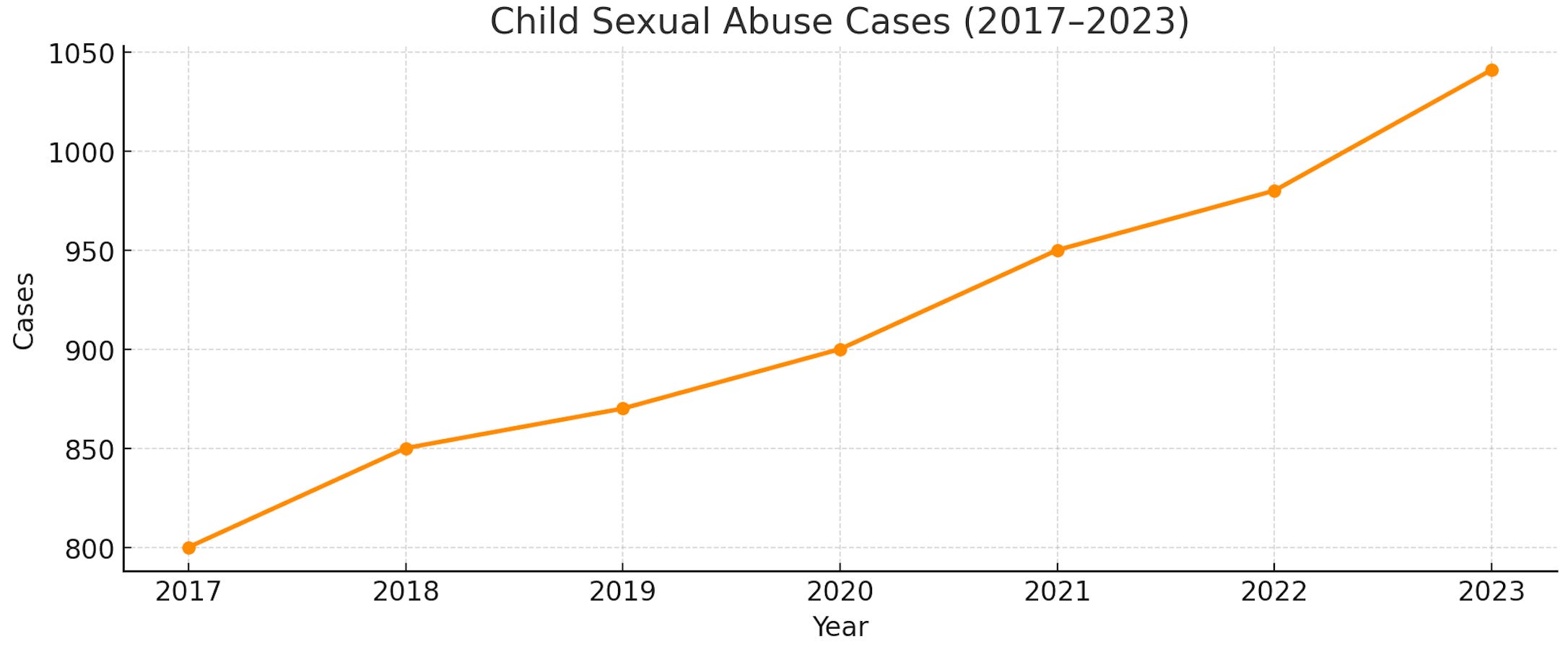
📊 Chart 3: Child Sexual Abuse Cases
Clear upward trend from 800 cases in 2017 to over 1,040 in 2023
Highest levels recorded in the last decade
To explore these figures in detail, one can consult the annual RASI reports (which dedicate sections to sexual crimes and usually include breakdowns of offenses like rape, sexual coercion, child abuse, etc.) and query the Justice Statistics portal for categories such as “crimes contra a liberdade e autodeterminação sexual” (crimes against sexual freedom and self-determination) on a year-by-year basis. These sources will provide the yearly breakdown by type of sexual crime that you are looking for, confirming the upward trend in sexual offenses since 2017 dn.ptexecutivedigest.sapo.pt.
Summary and Accessing the Data
In summary, Portugal’s official data demonstrate that violent crime decreased in the late 2010s (2017–2019) but has risen in the last couple of years, while sexual offenses have shown a steady rise from 2017 onward. The best places to find this data are:
Annual Internal Security Reports (RASI) – available on government websites (e.g. the Ministry of Internal Administration or Assembly of the Republic sites). The RASI for each year contains tables and analysis of crime trends, including violent and sexual crimes parlamento.ptapcd.pt. For instance, RASI 2022 and RASI 2023 provide comparisons to previous years and highlight the changes in those crime categories.
Ministry of Justice Official Statistics Portal – an online database where you can retrieve yearly crime statistics by category (e.g. you can look up total “violent crimes” or specific sexual offenses for each year). This portal is an official government resource and was used to report the 25% increase in child sexual abuse cases from 2019 to 2023 executivedigest.sapo.pt. It ensures you can obtain the breakdown by year and by type of crime in a format similar to what is published in RASI.
Both sources are official and up-to-date, and they corroborate the rise in violent crime and sexual offenses in Portugal since 2017, especially in the most recent years. By consulting these sources, you can get the exact numbers per year and detailed breakdowns (for example, by type of violent crime or specific sexual offense) to understand the scope of the increase. apcd.ptrtp.pt
Sources:
Ministério da Administração Interna – Relatório Anual de Segurança Interna, 2017–2023 editions parlamento.ptapcd.ptapcd.pt (official annual reports detailing crime statistics).
Ministério da Justiça – Estatísticas da Justiça (online portal for crime statistics) apcd.ptexecutivedigest.sapo.pt. This includes data on crimes recorded by police, by year and type.
Jornalistic summaries of RASI findings (Diário de Notícias, RTP, etc.) that cite official data – e.g. DN highlighting the 2017 rape figuresdn.pt, RTP and Expresso on the recent crime increases rtp.ptportugal.gov.pt, and JN/Executive Digest on the surge in sexual crimes against minor sexecutivedigest.sapo.pt. These help interpret the official numbers in context.